
e-Libya Initiative
To change for the better, for which the glorious February 17th revolution took place, the Ministry of Communications and Informatics took the initiative to propose and implement a set of national initiatives to place technology in the center of government operations and the private sector. Also enhancing the services provided to all citizens, residents and commercial establishments in Libya. E-Libya is one of the initiatives commissioned by the Prime Minister’s Office to provide all government services electronically to everyone wherever they are and at all times, using modern communication networks.

The success of this initiative requires the development of a comprehensive strategy for information technology to define the roadmap for the implementation of the main components of the initiative, which are:
- Libya's electronic infrastructure, including electronic services, networks, systems, shared data, security, and other infrastructure elements.
- •Redesigning and simplifying government services operations to provide the best services to residents and businesses in Libya.
- •Developing human resources to support electronic development, operation and maintenance of electronic services.
- •Establish laws, regulations, policies, strategic directions, performance monitoring measures, and other elements such as governance to ensure transparency and support electronic systems.
And by conducting a limited exercise and calling the major companies specialized in this field to submit their offers for the project to develop Libya’s electronic strategy, the bid for the project has been awarded to PricewaterhouseCoopers (PwC(.In accordance with the requirements of the administrative contracts regulation in the government , permission to contract with the company was obtained from the Prime Ministry as well as from the Audit Bureau. Permission was obtained from the council of ministers on 11/18/2012 and permission from the Audit Bureau on 1/1/2013. The scope of work of the Libya e-Strategy development project has been defined as follows:
• Second Stage: the strategic framework for Libya's electronic strategy:
- Developing the strategic framework (vision - mission - values - goals, principles and objectives)
• Third Stage: future reference designs for Libya's electronic strategy:
- Developing future reference designs (maximum 100 number) for government e-services.
- Developing future reference designs for Libya's e-strategy, which include infrastructure designs, joint government applications, shared electronic services applications, and data-Hubs. Also a platform for providing electronic services.
Fourth Stage: Roadmap and Balanced Scorecards
- Developing a roadmap to implement projects and initiatives related to Libya's e-strategy , in addition to risk management plans and communication management.
- Drafting and designing balanced scorecards for Libya's e-strategy, which includes performance and liability measures.
Fifth Stage: Governing Electronic Libya Program
- موذج التشغيل المستقبلي الخاص بإستراتيجية ليبيا الالكترونية
- Information Technology standards and policies.
- Laws and regulations for electronic transactions.
- Financing and spending options to implement Libya's e-strategy.
Fifth Stage: Governing Electronic Libya Program
- موذج التشغيل المستقبلي الخاص بإستراتيجية ليبيا الالكترونية
- Information Technology standards and policies.
- Laws and regulations for electronic transactions.
- Financing and spending options to implement Libya's e-strategy.
Sixth stage: pamphlets Terms and Specifications for Libya's E-Strategy Projects and Initiatives
- Developing brochures of conditions and specifications for Libya's electronic strategy projects and initiatives (23 as a maximum) for the first two years (first year and second year).
Seventh Stage: strategic frameworks for trade, education and government e-health programs.
- e-commerce program
- e-learning program
- e-health program
Eighth stage: knowledge transfer and project management:
- Training and knowledge transfer
- Project management and quality assurance
- Change management.
Project Roadmap
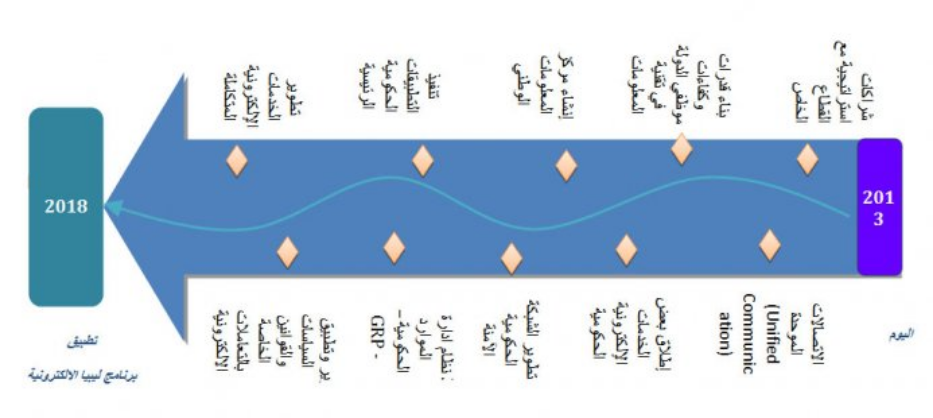
The main factors for the success of the E-Libya program
- Sponsoring the project by the higher authorities to ensure the participation of all government agencies within the program.
- The participation of stakeholders and the continuous pursuit of the implementation of change management activities.
- Actual application of the operational model and governance model of the e-Libya program
- Committing to providing the resources required for the success of the project (budget, human resources, etc.).
- Building and developing a central information center to provide common technical services and take advantage of leading global technologies (example: 'cloud computing')
- Building communication channels and the electronic portal for the e-Libya program
- Building communication channels and the electronic portal for the e-Libya program
- • Striving to win Arab and regional awards.
- Developing a comprehensive plan to develop the technical capabilities of stakeholders.
- Private sector participation and strategic partnerships with telecom service providers and IT companies in all fields.